Introduction
Many need independent evidence to enable the adoption of a story, because it increases the credibility of the narrative. Archeological discoveries support ancient historical stories and help us understand the culture and behavior of our ancestors. Same is true when it comes to Biblical stories. Alas, the further back in time one goes, the less evidence there is.
In this assay, let us look at the archeological discoveries that support the early formation of the Jewish People. The Biblical sections relevant to this period are Torah (first five books) and Joshua. The way one reads these stories is essential. Are they historically accurate accounts, or narratives that loosely connect to a real timeline? The answer to the above question shapes how the reader relates to the teachings and one’s takeaways from the stories.
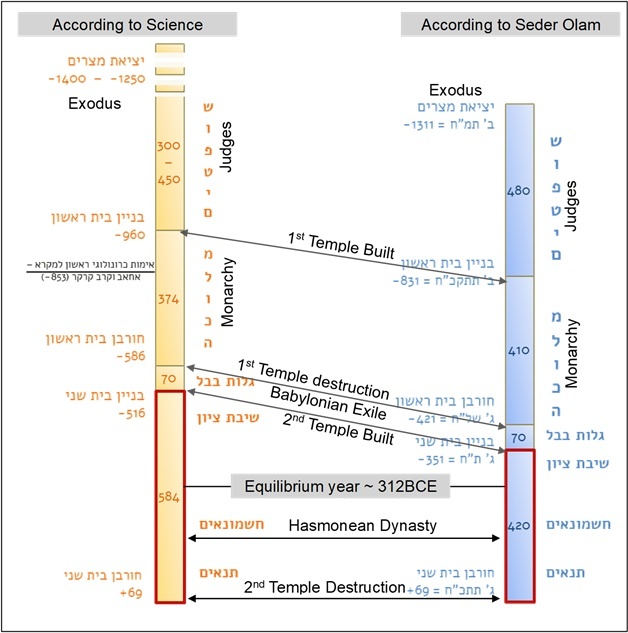
Another issue that rises when dealing with the subject is that there are two timelines to compare. The research-based “scientific” timeline and the Jewish Years count may differ for a specific event. The Jewish years count is based on “Seder Olam Rabba”, a 2nd-Century CE chronology of biblical events. The Jewish year count changes on Rosh HaShanah (around September); in September 2025, the Jewish year came to be 5786. Some events in Seder Olam miss several decades in comparison to the length of the same in the Scientific Calendar. The point in which the two calendars start to correlate is around 310BCE. The following chart (source: Wikipedia) shows the date differences of various events between the two calendars:
The Patriarchal Period
Many archeologists, historians and Bible researchers agree that there are no archeological findings that support the Patriarchs’ Biblical narrative. Prof. Ephraim Avigdor Speizer that researched the Nuzi Tablets claims that the customs described there resemble Biblical stories about Avraham and his family. A barren wife would give her maid to her husband to have successors, exactly as Sara offered Hagar to Abraham. And there are more examples that show similar parallels. That would date Avraham around 15th-century BCE, some 300-400 years later than the time of Avraham according of Seder Olam.
Prof. Binyamin Mazar, a reputed Israeli archeologist, claims that the Patriarchal period may be even later, probably circa 13th-century BCE. He connects the first archeozoological evidence of domesticated camels to the Philistines in G’rar that is mentioned in Genesis.
But then, tablets found in Mesopotamia describe the use of domesticated camels in the end of the 3rd millennium BCE. The researchers’ views of the Patriarchal period are that Avraham lived centuries later than what the biblical timetable shows. This is opposite to the difference in timing we find in later events, where the biblical timing is later than the common agreement among modern researchers.
The Sojourn in Egypt
Just as the preceding period, neither this has any archeological findings that support the biblical stories and narratives. A few findings in the tombs at Beni-Hasan and a few papyrus documents may relate to the biblical story.
Beni-Hasan is an Egyptian archaeological site on the Nile’s eastern bank, south of Cairo, dated to around the 19th-century BCE. Paintings in some of the 39 tombs show scenes of daily life and important biographical texts.
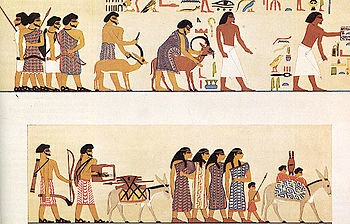
One of them show Semitic Bedouin merchants in richly colored garments entering Egypt. Prof. Binyamin Mazar compared the drawing to the description of the caravan that sold Joseph to the Egyptian Minister (Genesis 37:25).
A papyrus document (now in the Dutch National Museum of Antiquities) is dated circa 13th-century BCE. However, researchers believe that it relates to a much earlier period (19th-century BCE). It describes calamities that happened in Egypt in a language that resembles the Plagues, in particular the Blood Plague (“river is blood”). Another papyrus talks about the Haviru that built the Raamses Shrine (resembling the story in Exodus 1:3 stating that the Israelites built Pithom and Raamses).
Scholars agree that the Hyksos, coming from Ḥur and Canaan, ruled Egypt for more than a century around 1700 BCE. The meaning of Hyksos in ancient Egyptian is Rulers from Foreign Countries. The immigrants were shepherds, soldiers and craftsmen, very similar to the description in Genesis of the Sons of Israel. The Hyksos were expelled from Egypt by Pharaoh Ahmose the 1st, circa 1570 BCE. Many researchers consider the Hyksos as the Israelites, and their expulsion is the biblical Exodus.
The Exodus
This period has even less evidence with hard findings or ex-biblical sources to support it. The obvious reason is that most of the events happened while the Israelites wondered in the desert for 40 years. Instead of dealing with non-existing archeological findings, let’s explore who were the people that came out from Egypt.
The timing of Exodus according to the Biblical timetable Seder Olam is 1311 BCE. According to the Scientific calendar it happened anywhere between 1450 and 1250 BCE. Following the previously made assumption that Exodus was the expulsion of the Hyksos, it happened even earlier.
The Amarna letters and the Merneptah Stele (discussed later) can support the earlier dating of the Exodus. However, it cannot explain the absence of the Jericho Walls. The later dating would have a problem with the abovementioned evidence but could better explain the rise of Joseph (during the ruling of the Ḥaviru, another Semitic people) and the fact that there is no mentioning of Egypt in Joshua and Judges (except for one place, Judges 10:11).
On One Hand – Prof. Israel Knohl
Prof. Knohl suggest that the Israelites are decedents of three ethnic groups: the Hyksos, Mittani and Ḥaviru.
The Hyksos and Canaanite slaves that were expelled from Egypt in 1570 BCE. This group is the source of the stories about Joseph and the experience of expulsion and persecution. He claimed that the eruption of the Santorini volcano in Greece (circa 1570 BCE) created major climatic changes. Events such as rain, darkness, floods and deaths were recorded on the Tempest Stele that is dated to 1550 BCE. Interestingly, this stele was associated with Pharaoh Ahmose, the one that expelled the Hyksos. It so happened that Ahmose lost his first-born son at a young age, resembling the Plague of the First Borns. Prof. Knohl also relies on Josephus Flavius that connects the Israelite Exodus with the Hyksos.
The Mittani was a group from Ḥur in Assyria (named Naharain in Egyptian texts, similar to Aram Naharayim in the Bible). The Assyrian king Shalmaneser defeated them in a war around 1270 BCE; they may be responsible for the stories of Avraham and his decedents.
The Ḥaviru that escaped Egypt around 1210 BCE, at that time under the reign of Merneptah, the son of Raamses the 2nd. They were the slaves that built the pyramids for Ramses. They bring to the Israelite melting pot the myth of slavery and the monotheistic beliefs.
Obviously, this theory is criticized by others, not necessarily with facts and scientific logic; but what can one do if there is no hard unequivocal evidence?
On the Other Hand – Prof. Israel Finkelstein
Finkelstein asserts that the Exodus story was written towards the end of the First Temple Period (7th-century BCE), centuries later than the perceived events. He based his opinion on the biblical use of phrases and definitions that did not exist in earlier times. In addition, he claims that the description of life in the courtyards of the Pharaohs fitted a much later lifestyle. Finkelstein adds that archeological findings suggest that the Israelites gradually developed on the mountains of Canaan out of Canaanite tribes. The Exodus story is a vague reminiscence of the expulsion of the Hyksos in the 16th-century BCE.
The faculty of the Hebrew University in Jerusalem, among others, criticized this approach as well. Many archeological findings that unearthed later, especially in the City of David, contradict some of its fundamental assumptions.
Prof. Knohl, in contrast to Prof. Finkelstein, is a religious person. Does the difference in both religious affiliations allude to the difference in their approach to the Exodus narrative?
On the Third Hand – Ex Silentio (The Evidence in Silence)
The lack of any historical evidence also brings up some question marks. Egypt must have had a tremendous impact on its economy if 600,000 working slaves left it overnight. How come this impact is not mentioned anywhere at all? Losing its army in the Sea of Reeds would weaken Egypt and become vulnerable to attacks and takeover by enemies. None of that is mentioned in any document or known as an historical event. Perhaps, the narrative in the Torah does not reflect what really happen?
The Conquest of Canaan
There are four relevant findings to the period (or are they?) that will be referred to in this section. The question regarding their relevance stem from the uncertain time and form of the Exodus that preceded the Conquest. Or was there any conquest of Canaan at all (see Finkelstein’s theory, above)?
The Merneptah Stele
The Victory Stele of Merneptah, also known as the Israel Stele, describes the victory of Pharaoh Merneptah in 1207 BCE. Flinders Petrie discovered it in 1896 at Thebes and is now housed in the Egyptian Museum in Cairo. It states that there were a People called Israel in Canaan, in 1207 BCE.
It contains the earliest known to date of the reference to Israel outside the Bible itself, and hence its importance. It mentions Israel by name in lines 26 through 28:
“The Canaan has been plundered into every sort of woe: Ashkelon has been overcome; Gezer has been captured; Yano’am is made non-existent. Israel is laid waste and his seed is not; Hurru is become a widow because of Egypt.”
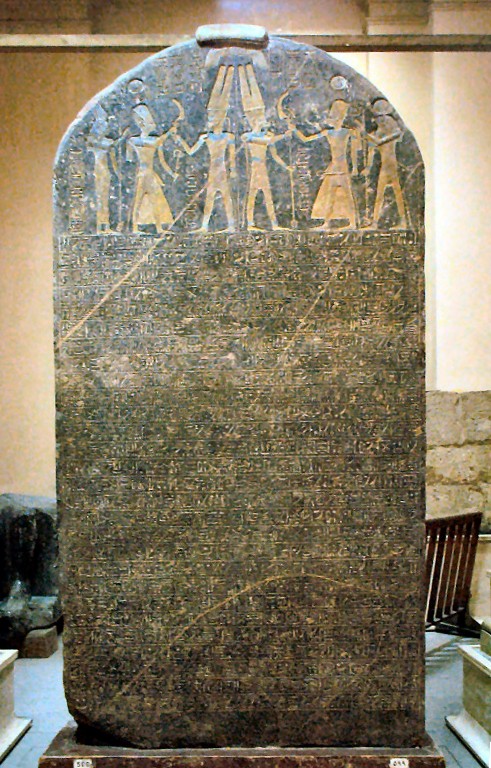
This is the very first mentioning of Israel that was known in history, some 3,200 years ago. There are additional steles that mention Israel, however, they are much later. The Mesha Stele, dated 840 BCE, mentions the House of Omri, that ruled Israel after the split to two kingdoms. The Tel Dan Stele (possibly between 870 and 750 BCE) is the first mentioning of the House of David in an ex-Biblical source.
This revelation undermines the foundations of the theory that the Exodus happened 1250 BCE, under Raamses the 2nd reign. It is highly unlikely that Israelites became an established nation in Canaan in such a short period after the Exodus.
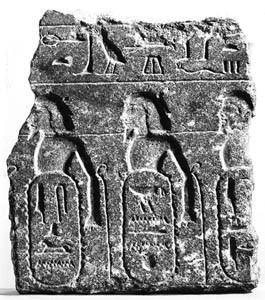
A relatively new finding may take the “world record” crown away from the Merneptah Stele. Lately, Manfred Görg studied a broken statue pedestal with his colleagues Peter van der Veen and Christoffer Theis. They used, among other sources, Merneptah Stele, to decipher the hieroglyphic name-rings and suggested that “Israel” was one of them. The inscription is dated to around 1400 BCE, some 200 years earlier than the Merneptah Stele.
Ebal Mountain Altar
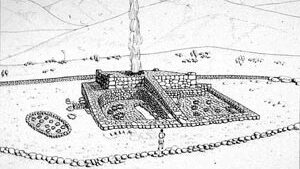
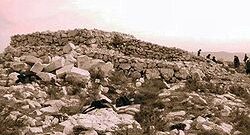
Mount Ebal dig reveals an elaborate and complex altar along with many remains of clay tools, animal bones and Scarabs. The findings were dated to the last quarter of the 13th century BCE (1225 – 1200 BCE).
A few of the findings substantiate that the alter is an evidence to the presence of the Israelites in Canaan:
- The access to the top of the Altar is via a ramp and not stairs (Exodus 20: 23);
- The altar was built from stones that were not cut or chiseled (Exodus 20:21, Deuteronomy 27: 5-6);
- The structure of the alter was quite similar to the Altar that was in the Mishkan (the Tabernacle);
- The bones were all of male, kosher for sacrifice one year old, animals.
As expected, critics weren’t too late to come, rebutted and re-rebutted. Let us Assume that the findings indeed correspond to Joshua entering Canaan and are evidence that Joshua fulfilled Moshe’s commandment (Deuteronomy 27:1-8). Then, one would have an issue explaining the Merneptah Stele, since they are of about the same vintage; logic would assert that the Merneptah Stele should be describing a much later event.
The Amarna Letters
Excavations made in El Amarna, Pharaoh Akhenaten’s Capital city, unearthed some 350 clay tablets from around 1350 BCE. They reveal the correspondence between the Egyptian administration and its representatives in Canaan. In one of them, the ruler of Jerusalem complains that the ruler of Shkhem is cooperating with the Habiru.
It stands for reason, relying on the biblical story, that the Israelites had some alliance with Shkhem. Jacob had a deed for a piece of land there (Genesis 33:18-20); Joshua gathered the Israelites in Shkhem after entering Canaan to reaffirm the blessings and curses on Mount Ebal (Joshua 8:30-33); The Israelites buried the bones of Joseph in the plot that belonged to Jacob in Shkhem (Joshua 24:32). All this could not have happened unless there was a pact of peace with the rulers of Shkhem.
This document supports the concept that the Exodus happened around 1400 BCE. There would have been enough time to roam the desert and conquer Canaan. Then, the Merneptah Stele would make sense. The war between described on it might have taken place during the reign of the Judges. Indeed, there is a single mentioning of Egypt in Judges (Judges 10:11), though not in a good way.
But, in that case, the Altar on Mount Ebal, which dates almost a century later, was not built by Joshua…
The Walls of Jericho
A disappointment awaits whomever expects that the bullet-proof, undisputable, evidence will come from this finding; be prepared for a pendulum swing!
Ernst Sellin and Carl Watzinger led the Austro-German first excavation in during the early 1900’s. They concluded that Jericho was unoccupied during the period when the Israelites first appeared in Canaan (circa 1350 BCE).
The British John Garstang questioned their conclusions and sought to gather evidence regarding the fortifications in Jericho. He concluded that “the walls fell, shaken apparently by earthquake, and the city was destroyed by fire, about 1400 BCE. The link with Joshua and the Israelites is only circumstantial but it seems to be solid and without a flaw”. With that, Garstang countered the negative conclusion of his German predecessors.
Garstang asked another British archaeologist, Kathleen Kenyon to review and update his findings. She applied more rigorous excavation techniques and detailed analysis of soil and debris layers in her work. She dated the walls destruction to a period which was at least several centuries earlier than Garstang claimed to be. Furthermore, she asserted that after that destruction, there was no settlement in Jericho for centuries. Ergo, there was no fight between the Israelites and the residents of Jericho when they entered Canaan.
Dr. Wood (see bibliography) did that and also analyzing pottery remains, scarabs that were found in a nearby cemetery along with radiocarbon dating of a charcoal sample that was found in the destruction debris of the Bronze Age city. He concluded that the destruction happened around 1400 BCE.
Then, there is a continuous argument about the accuracy of the radiocarbon dating. The initial test (dating to 1400 BCE) was found in error in 1993, and the correct answer was 1590 to 1527 BCE. This new dating was revalidated by testing grain samples and more charcoal in 1995 with dates ranging between 1640 to 1520 BCE and 1690 to 1610 BCE, respectively. These tests put the “truth” back to Kenyon’s dating.
Dr. Wood then argued that carbon dating is 100 to 150 years earlier than historical dates, and therefore he would rather put more emphasis on the historical data (pottery and scarabs). If one takes out the 100 – 150 years margin of error of C14 dating, the two estimates coincide.
Doug Petrovich form the University of Toronto says that around 1400 BCE both carbon dating and historical dating are consistent with each other. Therefore the error that Dr. Wood is referring to increases as one goes back in time; implying that at 1500 BCE the error would not be 100 – 150 years.
And the Debate continues…
Conclusion: Does it Really Matter?
At the end of the day, the reader may be confused: Did it all happen at all? Did the Patriarchs and Matriarchs exist? And if they did not, whom are we, the Jewish People, praying with and for every day for two millennia? The belief in the Exodus from Egypt is fundamental in Judaism and being supported in Christianity and Islam. If Exodus did not happen the way Scriptures describe, or did not happen at all, what are all the believers: fools??
Apparently not.
In my humble opinion, the Patriarchal stories, Exodus, the conquest of Canaan – in fact, all the Biblical stories – serve only as a skeleton. This framework holds the real essence of the Bible: the lessons that teach us how to treat each other with morality. The obsessive digging for the “absolute” truth of these details may divert one’s sight from the embedded truth in the story.
This truth surfaces in many ways through rules, laws, decrees and covenants, prophecies and parables:
Love to your neighbor as yourself I am The Lord
‘וְאָהַבְתָּ לְרֵעֲךָ כָּמוֹךָ אֲנִי ה
Leviticus 19:34:
The stranger who resides with you shall be to you as the native among you, and you shall love to him as yourself; for you were atrangers in the land of Egypt: I am the LORD your God.
כְּאֶזְרָח מִכֶּם יִהְיֶה לָכֶם הַגֵּר הַגָּר אִתְּכֶם, וְאָהַבְתָּ לוֹ כָּמוֹךָ כִּי גֵרִים הֱיִיתֶם בְּאֶרֶץ מִצְרָיִם אֲנִי ה’ אֱלֹהֵיכֶם
Asher Tzvi Greenberg, also known as Aḥad HaAm, wrote in the essay ‘Moshe’, his approach to the abovementioned dilemma:
It is a well-known fact that the heroes of history, those who became influencing forces on mankind for generations, are not at all the real persons that indeed may have lived at some time. Rather, there is no historic hero that his spiritual shape was drawn in the imagination of the People in a completely different way as it was in reality; and this imaginary portrait that the People created according to their needs and inclinations is the real Hero that continually influences, sometimes for thousands of years; and not the tangible original, that was a reality only for a short time, and even during that time the People did not perceive him as he really was.
When I see the scholars that are covered in the dust coming of books and ancient writings, all with the purpose to bring up from their graves the ‘Heroes of History’ in their real, true shape, believing that the ‘historical truth’ is worth losing their eyesight, I am telling myself: how far can they overestimate the value of their discoveries and not see the simple truth that not every archeological truth is also historical truth.
The historical truth is the one that reveals the forces that exist in the lives of a human society. If its influence is not negligible, even if by itself [the historical force, figure] is nothing but a fiction of imaginary entity, it is a real historical true force, and its real existence is historical truth. And the opposite statement is also true: if one’s influence is negligible on the general course of events and life, even if that one is a undoubtable reality, he is only one of many millions that their existence is real and true, but does not add nor subtract anything of the course of life, and as such, historically speaking, it does not exist.
As an example, one can take Goethe’s Werther [the main character of his novel “The Sorrows of Young Werther”]. Werther was only a fiction of Goethe’s imagination. But since its influence on that generation was so immense, causing many to commit suicide, he became real in the sense of Historical Truth, much more than any other real young German that actually lived then, and not in the imagination of a writer, and eventually died and was forgotten.
Therefore, I am not impressed at all when the scholars bring up in their ivory castle a new ‘truth’ regarding a known historical hero, showing black on white evidences that Joe Doe the national hero that lives in the heart of the people and influences the people’s spirit did not exist at all, or that his character was completely different from the image that the people have of him. Then I tell myself: All this is nice and good, and most likely, the new ‘truth’ will erase or modify a paragraph or a chapter in the archeology books.
But history will not erase its hero for that and will not change its attitude towards that hero. Because the real, true, history does not deal with Joe Doe the dead person that was not seen neither to the scholars nor to the people; it only knows the living hero that is engraved in the hearts of the people and becomes an active force that changes lives. For history, it really does not matter if that force was once a real, living and walking, man, or it was a figment of imagination that bore the name of a real Joe Doe. In any case, its reality is certain because history can see and show its influence on the course of life.
Note:
This article is a shorter version of the assay I wrote during my rabbinical studies. I am attaching the full Essay as a PDF file for those who are interested in a deeper analysis.
Powered By EmbedPress